The global semiconductor industry has become the foundation of modern technology, powering artificial intelligence, electric vehicles, cloud computing, data centres, consumer electronics, and advanced manufacturing systems worldwide. In 2026, the semiconductor market was valued at USD 0.74 trillion and is projected to reach USD 1.01 trillion by 2031, growing at a CAGR of 6.42%.
As countries focus on strengthening semiconductor supply chains and rely less on a few manufacturing hubs. Singapore has become a trusted global hub for advanced technology, producing about 10% of the world’s semiconductors and nearly 20% of global semiconductor equipment. The sector contributes around 6% of Singapore’s GDP and supports over 35,000 skilled jobs across manufacturing, engineering, R&D, and advanced packaging.
Supported by strong government incentives and more than S$30 billion in semiconductor investments between 2022 and 2025, the country continues to attract companies looking to expand semiconductor operations across Asia-Pacific markets.
Why the Semiconductor Industry is a Global Priority in 2026?
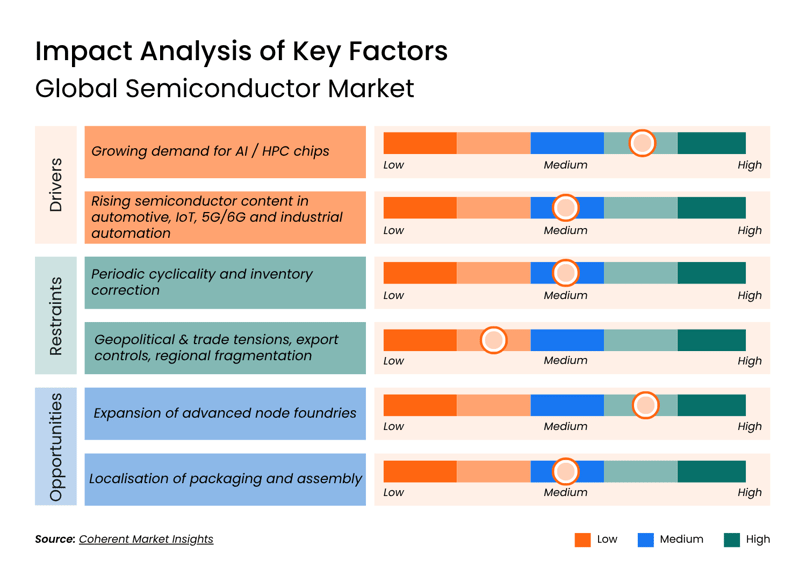
Semiconductors play a critical role in the global economy by enabling key sectors such as artificial intelligence, electric vehicles, cloud computing, telecommunications, defence, and advanced manufacturing.
As digital adoption accelerates worldwide, demand for high-performance chips continues to rise across AI infrastructure, data centres, industrial automation, IoT devices, and next-generation connectivity technologies like 5G and 6G.
At the same time, political conflicts, export controls, and recent supply chain disruptions have underscored the importance of secure, diversified semiconductor production. This has led governments and global technology companies to increase investments in chip manufacturing, advanced packaging, and localised production capabilities.
 Singapore Semiconductor Industry Outlook and Growth Trends
Singapore has developed one of the most advanced semiconductor ecosystems in Asia. According to the Singapore Economic Development Board, the country attracted more than S$30 billion in semiconductor investments between 2022 and 2025.
Today, Singapore accounts for:
- Around 10% of global semiconductor output
- Nearly 20% of global semiconductor equipment production
- One of Asia’s largest advanced packaging and testing ecosystems
Singapore’s semiconductor industry covers the full value chain, including:
- Wafer fabrication
- Semiconductor equipment manufacturing
- Advanced packaging
- Semiconductor testing
- AI chip research
- Photonics and materials innovation
The country’s strong intellectual property protection, stable regulatory environment, and highly connected logistics infrastructure continue to attract major global semiconductor companies.
Singapore Semiconductor Market Size
|
Metric |
Value |
|
Market Size (2025) |
USD 10.16 Billion |
|
Projected Market Size (2030) |
USD 14.15 Billion |
|
Forecast CAGR (2025–2030) |
6.90% |
Key Growth Drivers Impacting Singapore’s Semiconductor Market
Several factors and key technological advancements support the rapid growth of Singapore’s semiconductor industry.
|
Driver |
Estimated Impact on CAGR Forecast |
Geographic Relevance |
Impact Timeline |
|
Robust government incentives for advanced node fabs |
+1.20% |
Singapore with broader APAC impact |
Medium term (2–4 years) |
|
Surge in automotive-grade semiconductor testing demand |
+1.80% |
Global demand concentrated in Singapore testing hubs |
Long term (≥4 years) |
|
Expansion of data-centre developments in Jurong and Changi |
+1.50% |
Singapore cloud and AI infrastructure ecosystem |
Short term (≤2 years) |
|
Increased 3D-NAND production from Micron Technology Singapore mega-fab |
+0.90% |
Global memory and AI server markets |
Medium term (2–4 years) |
|
National AI compute roadmap supporting local chip design |
+0.80% |
Singapore and the regional AI ecosystem |
Long term (≥4 years) |
|
Growing adoption of silicon photonics for maritime 5G/6G applications |
+0.40% |
Singapore ports and maritime infrastructure |
Long term (≥4 years) |
Source: Mordor Intelligence
Top Government Grants for Semiconductor Companies in Singapore
Singapore offers multiple funding schemes and tax incentives to support semiconductor manufacturing, R&D, automation, and innovation in advanced electronics.
The government’s goal is to increase manufacturing output by 50% by 2030 while strengthening Singapore’s position in advanced technology sectors, supported by long-term national strategies such as the Research, Innovation and Enterprise (RIE 2030) Plan, which commits significant investment to advance deep-tech capabilities, including semiconductor innovation, AI-driven chip development, and next-generation manufacturing technologies.
Semiconductor R&D Initiative
Under Budget 2026, Singapore committed an additional SGD 800 million specifically for semiconductor R&D and ecosystem development. The initiative focuses on:
- Advanced packaging technologies
- AI semiconductor development
- 22nm and 28nm node expansion
- Semiconductor process innovation
- Talent and ecosystem development
The funding is to accelerate Singapore’s position in AI-driven semiconductor production and advanced manufacturing.
Enterprise Development Grant (EDG)
The Enterprise Development Grant helps companies improve operations, productivity, and business growth. The scheme, managed by Enterprise Singapore, supports up to 50% of eligible project costs and can be used for:
- Process automation and digitalisation
- Advanced manufacturing upgrades
- Production workflow optimisation
- Sustainability and energy-efficiency improvements
- Overseas expansion and market access
This grant is commonly used by semiconductor suppliers, engineering firms, and manufacturing businesses scaling operations in Singapore.
National Semiconductor Translation and Innovation Centre (NSTIC)
Singapore will launch the S$500 million National Semiconductor Translation and Innovation Centre (NSTIC) by 2027, announced under Budget 2025.
The initiative supports:
- Semiconductor prototyping and pilot production
- Shared cleanroom and testing infrastructure
- Advanced packaging and chiplet development
- Industry–research collaboration
- Semiconductor startup and fabless ecosystem growth
NSTIC is expected to help reduce barriers to commercialisation for semiconductor startups and deep-tech innovators.
Startup SG Tech Grant
The Startup SG Tech grant supports deep-tech and semiconductor startups developing proprietary technologies with strong commercialisation potential.
Funding includes:
- Up to S$250,000 for Proof-of-Concept projects
- Up to S$500,000 for Proof-of-Value projects
In simple terms, this programme aims to help early-stage companies move from technical validation to commercialisation.
Energy Efficiency Grant (EEG)
The Energy Efficiency Grant (EEG) supports companies investing in energy-efficient equipment and sustainable manufacturing practices.
The grant provides funding support of up to 70% of qualifying costs, subject to programme requirements.
Projects include:
- Energy-efficient manufacturing equipment
- Process optimisation initiatives
- Sustainable production technologies
- Energy management systems
- Carbon reduction projects
Note: From 2H 2026, Singapore will launch the EDGE grant program that will replace the Enterprise Development Grant (EDG), Productivity Solutions Grant (PSG), and Market Readiness Assistance (MRA).
How to Apply for Singapore Semiconductor Grants?
Applying for semiconductor grants in Singapore involves agencies like Enterprise Singapore, the Singapore Economic Development Board, and A*STAR.
The exact process depends on your business type, whether you are a startup, manufacturer, or working in semiconductor R&D or deep tech.
Step 1: Set up a Singapore Company
First, you need a company registered with ACRA in Singapore. Most grants require:
- Singapore-registered company
- CorpPass account
- Local business bank account
- Business activity aligned with semiconductors, electronics, AI chips, advanced manufacturing, or deep tech
Some programmes may also require:
- Local operational presence
- R&D activities conducted in Singapore
- Proprietary intellectual property (IP)
- Scalable commercialisation plans
Step 2: Understand Which Grant Fits Your Semiconductor Business
Different grants target different stages of semiconductor growth.
|
Grant Programme |
Best For |
Funding Support |
Key Focus |
|
Startup SG Tech |
Early-stage semiconductor startups |
Up to S$500K |
Prototype & commercialisation |
|
Startup SG Equity |
Deep-tech semiconductor startups raising capital |
Up to S$8M co-investment |
Scaling & VC matching |
|
Enterprise Development Grant (EDG) |
Manufacturing/process expansion |
Project-based support |
Automation & capability growth |
|
Tech@SG |
Semiconductor firms hiring global talent |
EP facilitation |
Talent acquisition |
|
A*STAR / NSTIC Programs |
Semiconductor R&D collaboration |
Case-by-case |
Advanced semiconductor research |
|
RISC Scheme |
Established semiconductor companies |
Enhanced R&D incentives |
Innovation & commercialisation |
Singapore recently committed about S$800 million toward semiconductor R&D under its RIE2030 strategy to strengthen chip innovation and advanced manufacturing capabilities.
Step 3: Prepare Required Documents
Semiconductor grant applications in Singapore are highly technical and documentation-heavy. Commonly required documents are:
- Detailed business plan
- Semiconductor technology roadmap
- Pitch deck
- IP ownership or patent filings
- Prototype or validation data
- Engineering specifications
- Financial projections
- Commercialisation strategy
- Founder and engineering team profiles
- Market opportunity analysis
- Cap table
Applications with clear technical depth and commercialisation potential generally perform significantly better.
Step 4: Build a Strong Technical and Commercial Case
Singapore agencies often prioritise semiconductor projects that support national strategic objectives.
Key Factors That Improve Approval Chances
- AI semiconductor relevance
- Advanced-node manufacturing capability
- Strong export potential
- Proprietary technology
- High-value job creation
- Supply chain resilience contribution
- Sustainability and energy-efficiency innovation
- Industry collaboration with universities or research institutes
Grant evaluators also assess if the technology has long-term global competitiveness and commercial viability.
Step 5. Submit Through the Relevant Portal
Applications are submitted through the appropriate Singapore government platform. Common submission channels are:
- Enterprise Singapore
- Business Grants Portal (BGP)
- EDB application channels
- A*STAR partnership programmes
Note: Most Singapore semiconductor grants do not reimburse expenses incurred before approval, so companies should ideally submit applications before beginning major R&D, hiring, equipment purchases, or facility investments.
Step 6: Participate in Technical and Commercial Evaluation
After submission, government agencies typically conduct several review stages.
Common Evaluation Areas
- Technical feasibility
- Semiconductor innovation potential
- Commercial scalability
- Export opportunities
- Economic contribution to Singapore
- Financial sustainability
- Industry relevance and strategic value
Applicants may also be asked to attend interviews, technical presentations, or due diligence sessions.
Step 7: Receive Grant Approval and Funding Offer
If approved, companies generally receive:
- Funding agreement
- Letter of Offer (LOF)
- Project milestones and KPIs
- Compliance and reporting obligations
- Funding disbursement schedule
Most grants follow milestone-based disbursement structures, where funding is released progressively upon achieving approved project targets.
Tax Incentives AI, and R&D Support for Businesses in Singapore
There are various tax incentives available to taxpayers involved in specified activities or industries identified as being beneficial to Singapore’s economic development.
To support businesses at different stages of growth, the Singapore government provides a range of tax exemption schemes.
Enterprise Development Grant (EDG)
-
The EDG supports businesses that invest in energy-efficient equipment. The grant provides up to 70% support for SMEs until March 31, 2027.
-
This grant is most suitable for SMEs and foreign-owned subsidiaries that aim to digitalise and pursue strategic growth.
Productivity Solutions Grant (PSG)
-
The PSG helps businesses adopt pre-approved IT solutions, software, and automation equipment to enhance operational productivity.
-
Funding for up to 50% of eligible costs, accelerating operational modernisation and process efficiency.
Market Readiness Assistance (MRA) Grant
-
The Market Readiness Assistance Grant helps with overseas expansion.
-
Funding is usually up to S$100,000 per market, for up to 70% of eligible expenses.
Startup SG Schemes
-
Startup SG Founder: Provides guidance and funding to new entrepreneurs.
-
Startup SG Tech: Supports startups with technology validation, proof of concept, and commercialisation.
Energy Efficiency Grant (EEG)
-
Supports businesses in adopting energy-efficient equipment and sustainable practices.
-
Funding for up to 70% of qualifying investments, promoting cost reduction and environmental performance.
Lifecycle-Based Tax Incentive Framework for Semiconductor Companies
Singapore’s tax incentive framework supports semiconductor businesses across different growth stages, from initial investment to long-term expansion.
These incentives are particularly relevant for companies involved in chip design and architecture, wafer fabrication and process engineering, advanced packaging and testing, semiconductor R&D and innovation, and regional headquarters or supply chain management.
Key incentives under this framework include:
- Refundable Investment Credit (RIC): Supports qualifying large-scale investments, with unused credits potentially refundable in cash, subject to approval.
- Pioneer Certificate (PC) Incentive: Supports new, higher-value, or first-of-kind activities carried out in Singapore.
- Development and Expansion Incentive (DEI): Supports companies expanding, upgrading, or deepening high-value operations in Singapore.
- Investment Allowance (IA): Provides additional tax allowances on qualifying capital expenditure for approved investment projects.
Together, these incentives make Singapore a competitive base for semiconductor businesses planning manufacturing, R&D, advanced packaging, testing, regional operations, or supply chain expansion.
Businesses should assess incentive eligibility early, as approval requirements, qualifying activities, and economic commitments can vary by project.
To understand how these incentives apply in practice, the table below outlines the main schemes, the type of business activity they are best suited for, and their relevance to semiconductor companies operating across the value chain.
|
Incentive |
Best Suited For |
Semiconductor Relevance |
|
Refundable Investment Credit |
Large-scale transformational investments |
Fabs, advanced packaging, R&D, automation, smart factories |
|
Pioneer Certificate Incentive |
New or first-of-kind capabilities |
New manufacturing processes and specialised production activities |
|
Development and Expansion Incentive |
Expansion and capability deepening |
Wafer capacity, R&D, regional headquarters, supply chain functions |
|
Investment Allowance |
Capital-intensive investments |
Cleanrooms, equipment, robotics, automation, precision systems |
Table: Key Singapore Tax Incentives for Semiconductor Companies
Future Opportunities in Singapore’s Semiconductor Industry
As the global semiconductor industry moves towards the $1 trillion mark by 2031, Singapore will likely continue to grow in semiconductor manufacturing, AI chip development, advanced packaging, and electronics production.
More global companies are choosing Singapore for their Asia-Pacific operations due to its stable business environment, strong infrastructure, skilled workforce, and government support. Investments in semiconductor R&D, manufacturing, and supply chain expansion are likely to increase further over the coming years.
If your company is looking to enter or grow in Singapore, Ascentium can assist with company setup, grant support, compliance, and business expansion. With local experience and practical advice, Ascentium helps businesses set up smoothly and grow with confidence in Singapore’s semiconductor sector.
Frequently Asked Questions
Start your Business in Singapore
Get expert guidance on Singapore’s semiconductor grants, tax incentives, and expansion opportunities.